When I was at the Interieur Design Biennale in Belgium, I did a few short blogs on all the new manufacturer introductions, but I’ve been saving the goods from the Young Designers Fair until today. Of all the things at this prestigious European furniture festival, these no-name designer prototypes were the things that impressed me most. The entering students and start-ups weren’t necessarily designing for mass appeal, for beauty, or even functionality; they were designing to shake things up. The call to entry was a search for a new creative process, an answer to current questions, and a source of motivation and inspiration through design.
Above is a hardware series by 28-year-old Johan Brunix that I simply adored. The hinges don’t move any differently than an average set, but by adding delicate wings, that movement becomes the flutter of a butterfly. From innovation that tips the scale to the small detail that makes you smile, the Young Designers Fair shows the future of design is in good hands.
Flash back to three weeks ago and my backyard was a DIY testing ground for nine painted-furniture projects. The paint has since dried, the hardware been screwed back on, the bugs picked out of the air-dried paint, and the furniture has been moved inside. Some of the projects were just paint touch-ups and others, you’ll see, were a decorative overhaul.
(Above) This desk and mirror just needed a fresh coat of white paint. They go so nicely together, I think I’m going to buy a little stool for it and use the setup as a vanity in the master bedroom.
This antique beveled mirror was originally a natural wood color, but we painted it poppy red to match the wallpapered accent wall in our guest bedroom.
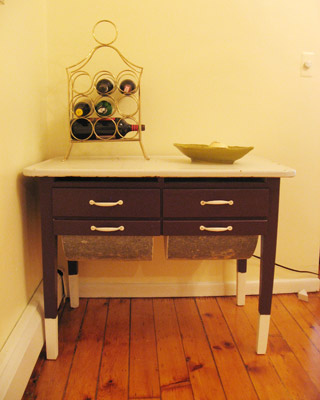
We loved this Macky Blue sideboard’s tin top and exposed tin bread drawers—despite its brutally chipping framework. We bought it knowing that, even with serious sanding, this piece couldn’t be smoothed over. So we vowed to try our best and chalk the remaining rough spots up to “character.”
Though the original paint job had a palette like a Greenbay Packer, the two-tone legs were really inspiring. We painted the piece plum but left the feet primer-white to match the tin top.
I still have dreams of having a tall chinoiserie china cabinet in my kitchen, but for $100 and a fun weekend project, this is a cute placeholder.
The greatest lesson I learned from Painted Furniture Weekend Part 1 was: NEVER strip furniture. It was the most disgusting, toxic, arduous yet deceptively easy project I’ve ever attempted for my home. The majority of the paint may gum up and peel off nicely, but the other 40% is a battle to get off the wood.
After stripping two sides of this piece, I abandoned ship and just went on to sand the front and top.
Note: Please ignore heinous boob tube TV on top of sideboard and ugly equipment below.
As you can see, our entertainment center is not ready, but we’d like to ultimately use this sideboard as a media console (when we buy a TV from the 21st century). To do this properly we’d take the top two drawers, cut off the fronts, and reapply them with hinges so they fold down for easy access to the DVD player and fold up to cover unsightly equipment.
In past years the winners of the Met Home of the Year Contest have run in the pages of the magazine but this year, the battleground for the modernist accolade, the luxe prizes, and the public praising is on PointClickHome. And it could all be yours if you enter your home by November 18th.
To give you a little taste of the competition we dug into our metcontest inbox and pulled out a house worth a mention: Trowbridge Farm. House is an understatement considering that we are talking about a 9,000-square-foot former hotel from the 1930s. When this couple first saw this Catskills behemoth in 1994, even in its state of disrepair with mushrooms growing on the living room floor and vines coming in the windows, they knew they had to have it. It took eight years to gut the 50-bedroom and ten-bathroom hotel, put on a new roof and plan the final renovation. We have to commend this labor of love and adore the historic and modern mix but the question is, is this:
The Met Home Dining Room of the Year?
The Met Home Living Room of the Year?
The Met Home Kitchen of the Year?
Help us decide if think this house or its individual rooms have what it takes…and if you think so, let us know with a comment, but if not, maybe you should put your home into the running.
To enter email methomecontest@hfmus.com and include photographs of your room/s and a short story of your home’s design. The best part of this contest is that in addition to whole house submissions, any space within your home is a viable entry (a mosaic tile floor, shaped like a zebra rug, is in the running right now, if that tells you anything). And for a $5,000 shopping spree to Mitchell Gold + Bob Williams or the great chance to win one of the 13 prizes for the Editor’s Favorite rooms–it’s worth an easy email entry.
Last call for submissions is November 18th, so be bold, be house proud, and send those pictures in to methomecontest@hfmus.com!
During a group lunch at Chez Fred in Antwerp with Interieur Designer of the Year Stephan Schöning, this topic came up: Why is there such great design in Belgium? The Belgians at the table mused about their history as the forefront of creativity in the Middle Ages and joked about their gloomy weather as source of productivity, but my reasoning? It’s the awe-inspiring cultural and governmental support for design across the country.
EXHIBIT A: Winkelhaak Design Center
Twenty-seven start-up design firms occupy this Antwerp building and each is given a furnished office for four, conference rooms, gallery space, a marketing team, a secretary, and basic catering—for free. The only down payment they make is a commitment to improve their business and a promise to leave within five years. With this government-subsidized program, the average design team leaves within three years because their company has outgrown the space.
EXHIBIT B: Design Platform Limburg
When the factories shut their doors in the mining town of Limburg and unemployment shot up, the community turned to design as a their salvation. With financing from Belgium and a Euregio (an organization of like-minded European regions) they founded Design Platform Limburg: a network of educators, financiers, marketers, and manufacturers especially created for young designers looking to launch their career. The town is now nationally recognized as a talent-breeding ground and design haven.
EXHIBIT C: Designer Give Back
On this trip we were introduced to a number of accomplished designers. I was inspired by the creativity in their work, but their humility and generosity impressed me the most. Fabiaan Van Severen who has an award-winning furniture line, also teaches design at four schools in Belgium. Sofie Lachaert, who designs for the ever-influential Dutch Droog, runs a gallery in Ghent where emerging talent gets the opportunity to present their work and get the necessary practical experience to succeed.
EXHIBIT D: Interieur
On the surface Interieur might look like a trade show, but it’s a national festival of design. It is open to the public for ten days and families, schools, local companies, and designers of all talents will all attend. The biennale was advertised in each of the four cities I visited and truly celebrated by all.
 When I was at the Interieur Design Biennale in Belgium, I did a few short blogs on all the new manufacturer introductions, but I’ve been saving the goods from the Young Designers Fair until today. Of all the things at this prestigious European furniture festival, these no-name designer prototypes were the things that impressed me most. The entering students and start-ups weren’t necessarily designing for mass appeal, for beauty, or even functionality; they were designing to shake things up. The call to entry was a search for a new creative process, an answer to current questions, and a source of motivation and inspiration through design.
 Flash back to three weeks ago and
  This antique beveled mirror was originally a natural wood color, but we painted it poppy red to match the wallpapered accent wall in our guest bedroom.
 We loved this
  Though the original paint job had a palette like a Greenbay Packer, the two-tone legs were really inspiring. We painted the piece plum but left the feet primer-white to match the tin top.
 I still have dreams of having a tall chinoiserie china cabinet in my kitchen, but for $100 and a fun weekend project, this is a cute placeholder.
 The greatest lesson I learned from Painted Furniture Weekend Part 1 was: NEVER strip furniture. It was the most disgusting, toxic, arduous yet deceptively easy project I’ve ever attempted for my home. The majority of the paint may gum up and peel off nicely, but the other 40% is a battle to get off the wood.
 After stripping two sides of this piece, I abandoned ship and just went on to sand the front and top.

 The Met Home Dining Room of the Year?
 The Met Home Living Room of the Year?
 The Met Home Kitchen of the Year?
 During a group lunch at Chez Fred in Antwerp with Interieur Designer of the Year Stephan Schöning, this topic came up: Why is there such great design in Belgium? The Belgians at the table mused about their history as the forefront of creativity in the Middle Ages and joked about their gloomy weather as source of productivity, but my reasoning? It’s the awe-inspiring cultural and governmental support for design across the country.
 EXHIBIT A:
  EXHIBIT B: Design Platform Limburg
 EXHIBIT C: Designer Give Back
 EXHIBIT D: Interieur